The CX gap in office buildings
Why some feel alive and others feel forgettable
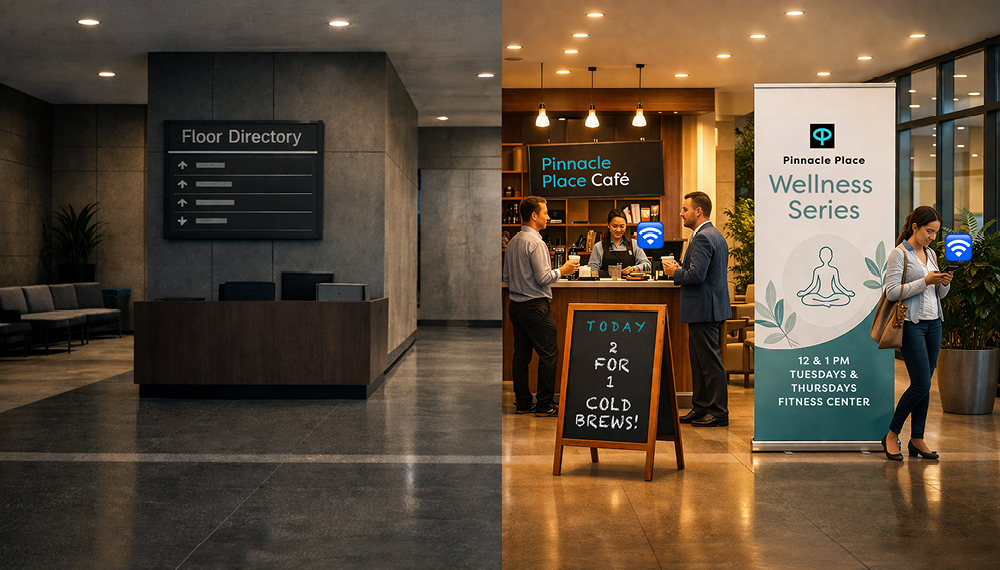
Have you noticed that some office buildings feel alive the moment you walk in?
There is energy. Communication feels clear. Amenities are visible and easy to access. Events feel connected to the people in the building. The overall experience feels thoughtful, coordinated, and current.
Other buildings may have strong fundamentals on paper, but still come up short in practice. The space is fine, the location may be good, and the amenity list may look competitive. But the day-to-day experience feels flat, fragmented, and forgettable.
The difference between a building that feels alive and one that feels forgettable is what we call the Customer Experience (CX) gap.
The CX gap is the space between what a building offers and what people actually experience.
In commercial real estate, that gap matters more than ever. Buildings are no longer competing on square footage alone. They are competing on how well they support people day to day, and on whether the workplace experience feels thoughtful, connected, and increasingly, hospitality-inspired.
That includes convenience, communication, service, and the sense that the workplace is worth returning to.
The CX gap shows up in everyday moments
The challenge is that the CX gap rarely appears in one dramatic way. More often, it shows up through a series of small moments.
An occupant wants to attend a building event but never sees the reminder in time. A tenant hears there is a fitness centre or food service offering onsite, but has trouble finding the details. A building service exists, but access feels unclear or cumbersome. A property update is sent, but not in a way people are likely to notice or act on. A problem is noticed in the building, but it is not obvious who to contact.
None of these moments seem major on their own, but together they shape how people feel about the property.
This is why some buildings feel active and engaging while others feel generic, even when both have invested in similar physical features.
Amenities alone don’t create experience
Workplace experience sometimes gets reduced to amenities. Gyms, lounges, food options, conference facilities, and retail offerings do matter, and they can all add value. But amenities by themselves are not the experience. They are only one part of it.
What matters just as much is whether people can easily discover, access, and engage with what the building already provides.
A great feature that is poorly communicated has limited value. An event with weak visibility will struggle to build community. A service that takes too much effort to find or use becomes friction instead of support.
The most memorable buildings do more than provide amenities. They create a distinct experience around them. They have a personality, a rhythm, and a point of view. In the same way great hospitality brands are intentional about how they make guests feel, office buildings have an opportunity to express their own brand, character, and sense of place.
That is where customer experience becomes the real differentiator.
The buildings that stand out are not always the ones with the biggest budgets or the most impressive lobbies. Often, they are the ones that pay closer attention to the everyday journey of their occupants. They make it easier for people to know what is happening, find what they need, take advantage of services, and feel connected to the spaces around them.
Great building experience feels hospitality-inspired
Closing the CX gap does not always require a major capital project. In many cases, it starts with something more practical: creating a more intentional, connected, and visible experience across the building.
When occupants can easily access updates, discover amenities, RSVP to events, complete a form, submit requests, and engage with building services from one place, the building starts to feel more responsive, useful, and connected.
That improves convenience, but it also changes perception.
People notice when a building makes their day easier and better. They notice when services are simple to find. They notice when communication is timely and relevant. They notice when the workplace feels like it is being actively managed as an experience, not just maintained as an asset.
And that perception has real value.
A stronger day-to-day experience can help support tenant satisfaction, reinforce the value of the property, increase participation in building programming, and create a more differentiated position in a competitive market. In a time when office buildings are working harder to attract and retain tenants, those things matter.
For landlords, asset managers, and property teams, the opportunity is not simply to add more features. It is to close the gap between what the building offers and what people actually experience, because that is often where the real difference lies.
Not in the fancy amenity. Not in the glossy leasing brochure. In the ordinary moments that shape the workday, and in how those moments make people feel.
The buildings people remember are usually not succeeding by accident. They feel alive because the experience has been considered, supported, and made visible. They feel distinct because they reflect a clear identity, not a cookie cutter formula.
In today’s office market, customer experience is no longer a nice layer on top of the asset. It is part of how the asset competes.
Now is the time for building owners and operators to examine the small moments that shape how people experience their properties every day, and to ask whether that experience truly reflects the brand, hospitality, and soul of the building.
The buildings people return to are the ones that make people feel something.