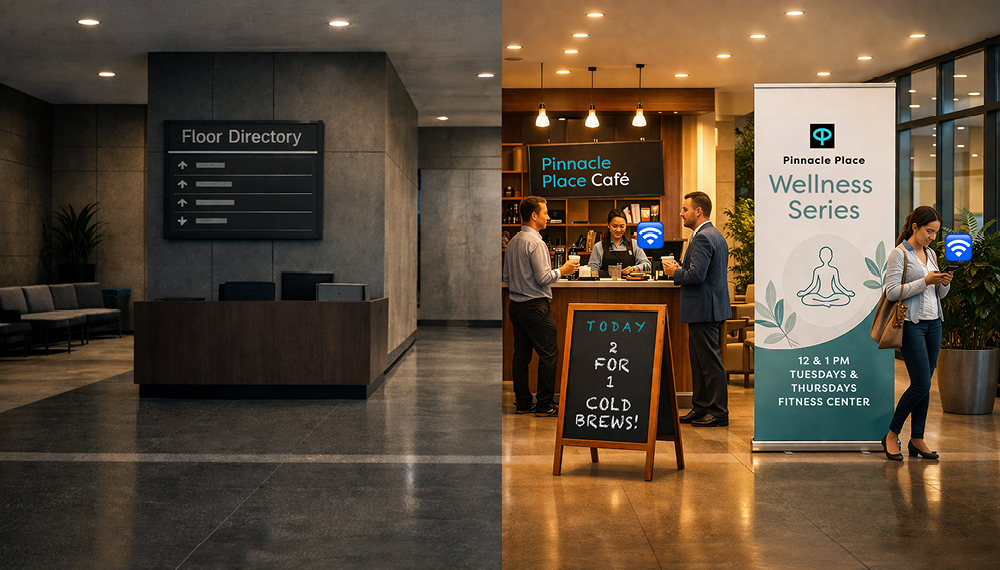
How integrated workflows reduce friction and improve the workplace experience
Today’s office buildings must deliver more than clean, safe, well-managed space. They are expected to deliver a better experience for the people who work in them every day.
That expectation has changed the role of building operators. Owners and managers are not only responsible for maintaining the physical asset. They are also responsible for creating a workplace environment that feels responsive, useful, organized, and easy to engage with.
But behind many building experiences, there is still a surprising amount of manual work.
Requests come in by email. Forms are attached as PDFs. Information gets copied into spreadsheets. Staff send confirmation emails, track approvals, update lists, and follow up when details are missing.
None of these tasks may seem significant on their own. But over time, they create operational friction for building teams and a less seamless experience for tenants.
This is where integrated workflows can make a meaningful difference.
The work behind the workplace experience
A strong customer experience in an office building depends on what happens behind the scenes.
When someone requests an access card, registers for secured bike parking, signs up for an event, submits a waiver, books an amenity, registers a visitor, or contacts the building team, the process should feel simple.
For the tenant, it may be one quick interaction.
For the building team, it can involve several steps, multiple systems, and different people responsible for moving the request forward.
The tenant does not see the internal process. They only feel the result. Was it easy to submit the request? Did the building team respond quickly? Was the next step clear? Did they receive confirmation? Did the experience feel organized?
Those details matter because they shape how people perceive the building.
When the process is manual or fragmented, friction becomes visible. Tenants may need to send follow-up emails, resubmit missing information, wait for confirmation, or contact the management team to understand what is happening.
When the process is integrated, the experience feels more consistent. Requests are easier to submit, easier to track, and easier for building teams to manage.
Better workflows do not only help teams save time. They help the building feel more responsive.
Manual processes create hidden costs
Many operational tasks in commercial office buildings still rely on tools and habits that were never designed to work together.
A tenant sends an email. A team member downloads an attachment. Someone prints a form, collects a signature, updates a spreadsheet, forwards the information to another team member, and sends a confirmation.
The task gets done, but the process is inefficient.
The hidden cost is not only the time spent completing the task. It is the repeated administrative effort behind every request. It is the lack of visibility when information lives in separate inboxes, folders, forms, and spreadsheets. It is the difficulty of knowing what has been submitted, approved, declined, completed, or still in progress.
It also creates inconsistency.
One tenant may receive a quick response. Another may wait longer because the request was sent to the wrong person. One team member may track information in a spreadsheet. Another may keep notes in an inbox. Over time, these small differences can make operations harder to manage and harder to measure.
For building operators, that matters.
Operational efficiency is not only about reducing work. It is about creating clearer, more reliable processes that help teams deliver better service at scale.
What measurable efficiency gains can look like
Not every efficiency gain needs to be expressed as a single number.
For building operators, measurable improvement often starts with the practical things teams can see, track, and compare over time.
Integrated workflows can help reduce the number of manual emails required to process common requests. They can reduce the time spent collecting missing information. They can make it easier to review and approve tenant submissions, maintain cleaner records, and understand the status of each request.
They can also reduce reliance on printed forms, scanned documents, separate spreadsheets, and manual confirmation emails.
For event planning, integrated workflows can help building teams track RSVPs, manage capacity, export registration lists, and communicate more clearly with attendees. For access card requests, they can help collect the right information upfront and give teams a clearer view of each submission. For amenities, waivers, visitor registration, bike parking, service requests, and building programs, they can turn repeated administrative tasks into structured processes.
These improvements may not always be dramatic on their own. But when they are applied across the daily operations of a busy office building or a portfolio of properties, they add up.
They save time. They reduce friction. They create better records. They help teams respond faster. They make it easier to see what is happening across the building.
Most importantly, they make operational efficiency visible.
As Nancy Savard, Manager, Tenant Services at JLL, shared:
“HILO activated our 1M SF office complex from a legacy building app to our new branded platform and integrated several automated workflows that saves time and simplifies tasks for our tenants and operations team.”
That is the value of integrated workflows. They simplify the work for the people managing the building and for the people using it.
Workflows are part of the customer experience
For tenants, the value is not “workflow automation.” The value is that the building becomes easier to use.
A tenant should not need to know which department handles a request, which form is required, who approves it, or which email address to contact. They should be able to complete common tasks from the same place they already receive building news, updates, event invitations, amenity information, and service communications.
That is why workflows should not be treated only as back-office tools. They are part of the customer experience.
When workflows are integrated into the building’s digital experience, tenants can interact with the property more easily. They can submit requests, register for events, complete forms, access services, and receive confirmations through a more consistent process.
The building team benefits from better structure and visibility. Tenants benefit from a simpler, more reliable experience.
That connection matters because customer experience in office buildings is built through many small interactions. A single request may not define the building, but the pattern of those interactions does.
If everyday tasks feel confusing, slow, or disconnected, the building feels harder to engage with. If everyday tasks feel simple, clear, and organized, the building feels better managed.
One place to see what is happening
A platform like HILO helps building operators bring tenant engagement, communications, services, and workflows into one connected customer experience platform.
The goal is not to add more technology for the sake of it. The goal is to reduce the number of disconnected steps that building teams and tenants are forced to manage.
Instead of relying on email, paper forms, PDFs, spreadsheets, and separate tools, teams can manage activity in one place. That makes the practical questions easier to answer.
What came in? Who submitted it? What information was included? What is the current status? Who needs to act? What has been completed? What can be exported or reported on?
For a single building, that visibility helps the team work more efficiently. Across a larger portfolio, it helps operators create more consistent processes, cleaner reporting, and a better understanding of how tenants are engaging with the property.
That kind of visibility is becoming more important as buildings invest in more programming, amenities, services, hospitality, and tenant engagement.
The more a building offers, the more important it becomes to manage the operations behind those offerings well.
Why this matters now
Office buildings are under more pressure to prove their value.
Owners and managers are investing in better amenities, stronger tenant communications, more thoughtful programming, and hospitality-inspired services. These investments are important, but they only work when the operational experience behind them can support the promise being made.
A tenant event is stronger when registration is simple. A bike room is more valuable when registration is easy to manage. A building service is more useful when requests are simple to submit and track. A customer experience platform is more effective when it connects the everyday interactions that people rely on.
Buildings are no longer judged only by their location, finishes, and amenities. They are judged by how useful, responsive, and easy they feel to the people inside them.
That does not happen by accident. It requires operational systems that help teams deliver a more consistent experience.
Better operations create a better building experience
A building that relies on disconnected manual processes can feel static. A building with integrated workflows can feel more responsive.
The future of office building operations is not only about adding more amenities or more technology. It is about connecting the everyday interactions that shape how people experience the building.
Integrated workflows help building operators reduce friction, streamline operations, and deliver a more consistent customer experience.
For owners and managers looking to make their properties easier to operate and more valuable to the people inside them, the opportunity is clear: start by improving the everyday processes that tenants and teams rely on most.
HILO helps office buildings bring tenant engagement, communications, services, and workflows into one connected customer experience platform.
Better operations create a better building experience.