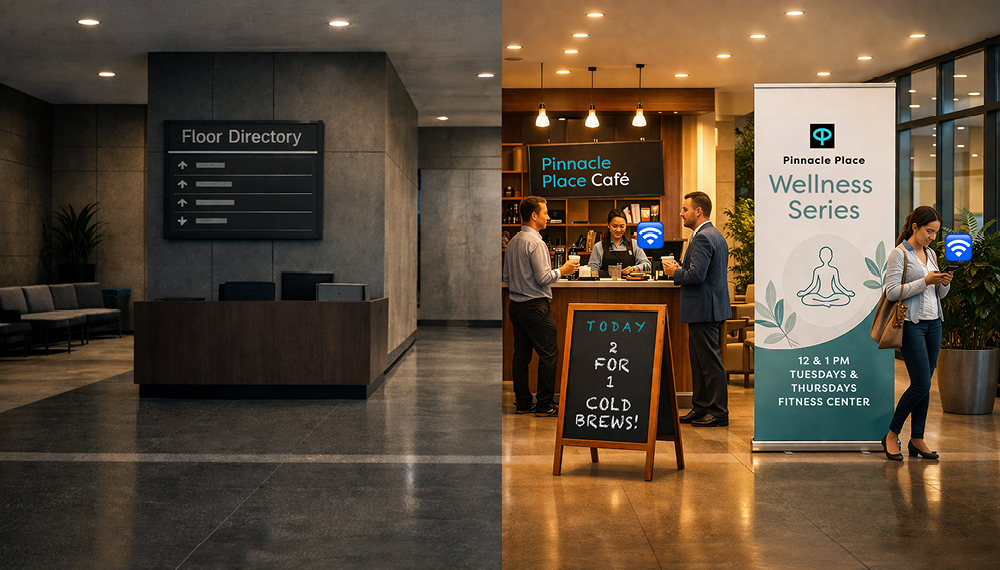
The workplace experience is a shared responsibility
Building operators manage buildings. Tenants manage workplaces.
That’s how the responsibilities have traditionally been divided. Building owners oversee the property, common areas, building systems, amenities and shared services. Tenant organizations manage their offices, workplace policies, employee communications and company culture.
But employees don’t experience those responsibilities separately. They experience one workplace.
A difficult visitor process, limited food options, an uncomfortable meeting room, an unclear building update or a delayed service request all contribute to the same overall impression. Employees rarely stop to consider whether an inconvenience is controlled by the landlord, their employer or a third-party provider.
They simply know whether the workplace feels welcoming, convenient and responsive.
That’s why delivering a strong workplace customer experience increasingly requires building operators and tenants to work together.
A shared customer requires shared responsibility
Building owners have traditionally viewed the tenant organization as their customer. Employers, in turn, focus on the needs and expectations of their employees.
In practice, both are serving the same person.
Employees begin interacting with the workplace before they reach their company’s front door. They use the parking facilities, lobby, elevators, food services, shared amenities and common areas. They receive building communications, attend property events and rely on services that may be managed by several different organizations.
Each interaction shapes their perception of the workplace.
The landlord can’t control the tenant’s company culture, workplace policies or in-suite experience. The tenant can’t control the building’s systems, common spaces or property services. Neither party can deliver the complete experience independently.
The strongest workplaces are created when both sides recognize that they share responsibility for the people using the building.
That alignment also reflects a practical reality. Owners need satisfied tenants, active properties and strong retention. Employers need workplaces that support productivity, culture, recruitment and employee satisfaction.
Both have an interest in making the office a place where people can work effectively and have a positive experience.
Collaboration must extend into daily operations
Building-tenant collaboration is often associated with major moments such as lease negotiations, renovations, fit-outs and capital improvements.
Those decisions matter, but the workplace experience is shaped every day through smaller and more frequent interactions.
It’s influenced by how quickly a comfort complaint is addressed. Whether employees know that an amenity is available. How easily they can register for an event, request a service, book a shared space or find important building information.
These moments may seem operational, but together they determine whether the workplace feels organized and attentive or confusing and disconnected.
Meaningful collaboration can’t be limited to occasional meetings between senior representatives. It needs to become part of the building’s ongoing operating model.
Property teams, tenant contacts, workplace leaders, human resources and communications teams all hold different pieces of the experience. They need reliable ways to share information, coordinate services and respond to changing employee needs.
Shared digital tools can help by giving property and tenant teams a clearer way to distribute information, coordinate activities and follow requests through to resolution.
This doesn’t mean every decision needs to be made jointly. It means both sides should have a clearer understanding of what the other is trying to achieve and where their responsibilities intersect.
Better service begins with better understanding
Amenities are often treated as a central measure of workplace quality.
Fitness centres, lounges, meeting spaces, outdoor areas, wellness facilities and food programs can all add value. But an amenity doesn’t improve the experience simply because it exists.
Employees need to know about it, understand how to access it and see how it fits into their working day.
A well-designed shared space that sits empty because it hasn’t been communicated effectively delivers limited value. A useful service with a complicated booking process can create more frustration than convenience. An event that doesn’t reflect employee interests is unlikely to build meaningful engagement.
This is where closer landlord-tenant collaboration becomes important.
Tenants often have a better understanding of employee expectations, workplace routines, attendance patterns and recurring concerns. Owners have a broader view of building operations, shared resources and the opportunities that exist across the property.
Bringing those perspectives together can help both parties make better decisions.
The answer may not be another amenity. It may be clearer communication, more flexible access to existing spaces, improved food options or a faster way to resolve common requests.
For many buildings, particularly those that can’t compete by continually adding expensive facilities, responsiveness can become a powerful differentiator.
A building that listens, communicates clearly and adapts to how people actually use the workplace may create greater customer value than one with an impressive amenity list but limited connection to its occupants.
Communication and feedback connect the experience
Strong collaboration requires more than sending announcements.
Owners need to understand what tenants and employees value, where friction is occurring and how shared services are being used. Tenants need visibility into what the building offers, what’s changing and how their employees can participate.
That exchange needs to move in both directions.
Which services are being used? Which communications are being overlooked? Where are requests becoming delayed? What programs generate genuine participation? Which recurring concerns point to a larger operational issue?
Annual surveys can provide useful insight, but they offer only a snapshot. The workplace experience changes from day to day as employee habits, tenant needs and building operations evolve.
Owners and tenants need practical ways to gather feedback, review participation and identify patterns over time.
The goal isn’t simply to send more messages. It’s to deliver more relevant information through a channel employees already know how to use, and to understand whether that communication is working.
Technology can make that possible by helping teams target information, track engagement and identify where employees may need greater clarity or support.
Technology can connect a divided experience
The workplace may be managed by different organizations, but employees shouldn’t have to navigate those divisions.
Technology can provide a shared layer that connects building communications, services, amenities, requests and feedback in one place. Instead of asking employees to understand which team is responsible for what, it can give them a simpler way to find information, access services and get help.
For property teams and tenants, that same environment can improve coordination behind the scenes.
Building updates can be shared with the right audiences. Amenities and events can be promoted to the people they’re most relevant to. Service requests can be routed, tracked and resolved more consistently. Tenant contacts can share information with employees without relying on long email chains or disconnected systems.
Technology can also make the workplace easier to understand.
Usage data can show which services are valued, which amenities are underused and which communications are reaching people. Feedback can reveal recurring points of friction. Over time, those insights can help owners and tenants make better decisions about where to invest, what to improve and what employees actually need.
This is particularly important when workplace needs vary between buildings, tenant organizations and employee groups. A single set of assumptions won’t serve everyone equally. Better information allows services and communications to become more relevant to the people using them.
Technology shouldn’t replace personal service or direct relationships. A platform can’t create trust, responsiveness or collaboration on its own.
But it can give owners and tenants a more practical way to work together, maintain a shared view of the workplace and deliver a more consistent experience to the people they both serve.
A better outcome for everyone
Stronger collaboration creates a better outcome for everyone involved.
For owners, it can improve tenant satisfaction, strengthen retention and help the building stand apart in a competitive market.
For tenants, it can support employee experience, workplace culture and productivity without requiring every service to be created and managed independently.
For employees, it can make the workplace easier to navigate, more responsive and better connected to their needs.
This doesn’t mean building operators and tenants will always have the same priorities. Questions about cost, responsibility and service expectations will continue to require discussion and negotiation.
But both sides are ultimately working toward a similar outcome: a workplace that supports how people work, connect and experience their day.
One workplace shouldn’t feel fragmented
The quality of a workplace is shaped by many organizations, systems and daily interactions. To the person using it, however, those divisions are largely invisible.
Every message, request, service, amenity and shared space contributes to one experience.
That’s why stronger collaboration requires more than goodwill. Owners and tenants need practical ways to communicate, coordinate services, listen to employees and understand how the workplace is being used.
At HILO, we believe technology should connect those responsibilities, not create another layer between them.
When owners and tenants have a shared view of the workplace customer, they can respond more effectively, use resources more intelligently and create an experience that feels consistent from the building entrance to the tenant’s front door.
The workplace experience may be a shared responsibility, but it should never feel fragmented.